
Positions
Digital Health Solutions as the Economic Infrastructure of Medical Sovereignty
Medicine in Transition – Navigating a Digital Economy
Medicine is undergoing a profound transformation. Artificial intelligence (AI) is reshaping not only diagnostics and therapy but also the economic mechanisms of healthcare. Physicians who once operated purely within clinical boundaries now face a dual responsibility: to be clinically excellent and strategically entrepreneurial.
Medical education rarely prepares doctors for this reality. While AI-powered tools and digital platforms unlock new efficiencies, many physicians lack the economic literacy to harness these opportunities effectively. The result: rising workloads, financial pressure, and growing dependence on administrative structures.
In this environment, business competence becomes a form of professional protection — safeguarding against burnout, loss of autonomy, and the reduction of medical practice to mere service provision. It empowers physicians to act independently within a system increasingly defined by data, platforms, and scalability.
The Physician as an Architect of a Digital Care Economy
Amr Saad views business competence not as the opposite of medicine, but as its natural extension. Modern medical leadership means combining clinical precision with economic accountability.
In this framework, economic thinking becomes a core medical skill, enabling doctors to deploy digitalization purposefully. AI, telemedicine, and digital patient education — such as through PatientEd — not only enhance diagnostic accuracy but also optimize resource allocation.
Digital solutions create time, not bureaucracy. When screening, patient education, and follow-up are digitally supported, physicians can care for more patients, open new service areas, and refocus on their core clinical mission.
This gives rise to a new model of medical value creation — not through higher case numbers, but through better resource circulation, streamlined processes, and innovative care models. AI and business acumen become two sides of the same coin: technology unlocks potential, while economic understanding turns it into impact.
Mechanism of Change – Digital Efficiency as Empowerment
The physician’s role is evolving from isolated decision-making to strategic care management. Business competence enables doctors to integrate digital tools into clinical and administrative workflows — structurally, efficiently, and responsibly.
“AI is not the doctor’s competitor, but their co-pilot — and business competence is the navigation system that keeps the flight safe.” Digital health solutions like AI diagnostics and platforms such as PatientEd are not just technological advancements — they are economic levers. When repetitive education and documentation tasks are automated, medical teams regain valuable time — which can be reinvested into expanded services or direct patient care.
“Digital precision does not replace medicine — it expands the physician’s scope of action.”
The result is a new workflow logic: Automated pre-education → AI-supported analysis → medical interpretation → additional services through freed-up resources. This turns digital health from a cost factor into a care investment.
Efficiency Through Digital Intelligence
Efficiency Through Digital Intelligence
For the healthcare system:
- Relief through more efficient processes and lower operational costs
- Improved quality via standardized, AI-assisted diagnostics and communication
- Scalable care capacity with stable workforce levels
For physicians:
- More time for complex cases through digital process relief
- Strengthened autonomy through economic and strategic understanding
- Expanded professional identity – from practitioner to decision-maker
For patients:
- Faster, more precise care enabled by AI-assisted systems
- Greater transparency and understanding via interactive digital education tools
- Access to new forms of care, regardless of geography or capacity constraints
Personal Initiatives
To embed this transformation mindset, Amr Saad completed an MBA, gaining strategic insight into healthcare economics and decision-making. This knowledge enables him to design digital solutions that not only meet medical standards but also enhance efficiency and expand access rather than fragmenting care.
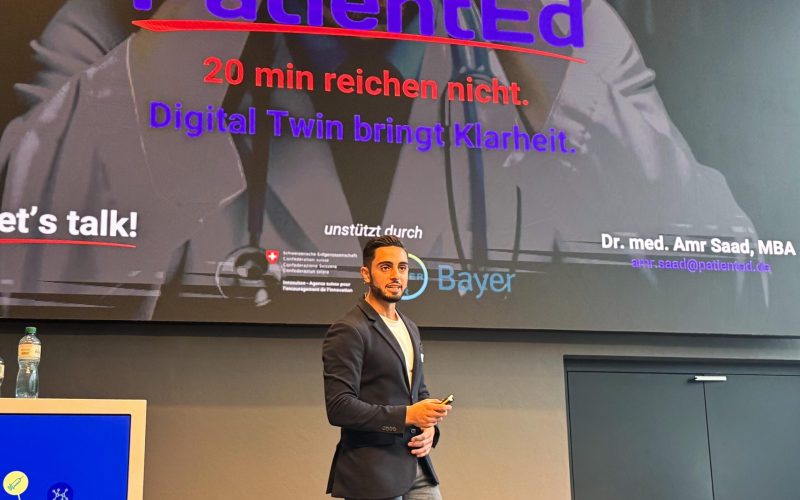
Through PatientEd, he is developing a platform that not only digitizes patient education but also creates new, scalable business models for clinics and healthcare institutions — transforming knowledge into a sustainable economic asset.
In parallel, he shares this perspective as a speaker and thought leader, inspiring a new generation of physicians to align medical and economic logic and shape the digital health economy from within.
His conviction is clear:
Economic thinking protects medicine – and digital innovation creates the space for it.