
Positions
Digital Health as a Logic of Care – The Clinical Co-Pilots of an Empathic Medicine
Skepticism and Implementation Gaps Despite Technological Maturity
Digital health holds enormous potential in ophthalmology: AI models achieve over 90% diagnostic accuracy in classifying retinal diseases (JAMA Network Open, 2025), tele-ophthalmology reduces escalations to secondary care by up to 50% (PubMed, 2025), and LLM-based systems measurably improve the completeness of anamnesis (Nature Digital Medicine, 2025). Yet, these capabilities remain largely unused.
Two central barriers prevent systemic integration:
- Skepticism in clinical practice: Digital solutions are still perceived as experimental rather than as workflow-compatible care tools. Many physicians fear that AI could replace empathy or undermine clinical autonomy.
- Implementation and interoperability issues: Technical maturity does not guarantee clinical adoption. Without interoperable interfaces, defined implementation pathways, and seamless workflow integration, digital health remains a theoretical option — not an operational reality.
Digital Health as Inclusive Innovation
Amr Saad defines digital health not as a technology rollout, but as inclusive innovation — combining clinical precision, human empathy, and digital scalability. AI is not a replacement for medical expertise; it is a clinical co-pilot that identifies patterns, highlights risks, and elevates doctor-patient communication to a new level.
In this logic, digital healthcare means:
- AI as an early-warning system – predictive analytics for DR, AMD, and glaucoma before symptoms occur.
- Telemedicine as continuity, not substitution – especially for chronic follow-up and postoperative care.
- Digital patient education as a third care layer – PatientEd as an interactive dialogue system that strengthens understanding, adherence, and shared decision-making.
Digital health thus becomes the architecture of care, not an auxiliary layer of technology.
Storytelling as a Pathway to Implementation
Digital transformation succeeds not through regulation, but through understanding and experience. Implementation must be narratively guided to foster trust and adoption: “Imagine your smartphone functioning as a digital ophthalmologist — not to replace diagnoses, but to warn you early, explain correlations, and enable meaningful, informed conversations with your doctor.”
The physician receives an AI-assisted second opinion; the patient gets a transparent, visually supported explanation. This model of hybrid medicine — humanity powered by data — is the essence of digital health.
Digitalization does not replace the physician; it extends their reach, precision, and relationship with patients.
Such storytelling creates emotional accessibility and translates technical systems into clinically meaningful processes: Screening → Digital Pre-Interpretation → PatientEd Explanation → Shared Decision-Making → Telemedical Follow-Up.
Digital Health as a Care Economy
Digital health begins where technology enhances understanding, precision, and empathy simultaneously.
For healthcare systems:
- Early intervention lowers escalating costs and relieves secondary care
- Digital workflows free up physician time for complex cases instead of adding documentation
- Predictive algorithms enable scalable monitoring and continuous care
For physicians:
- Relief from repetitive diagnostic and explanatory tasks
- Improved decision-making through assistive AI systems
- Enhanced communication via interactive, personalized patient-education tools
For patients:
- Early risk detection for asymptomatic conditions
- Understanding rather than just information – PatientEd as a navigation tool through therapy pathways
- Accessible care via mobile devices and tele-follow-ups
Personal Initiatives
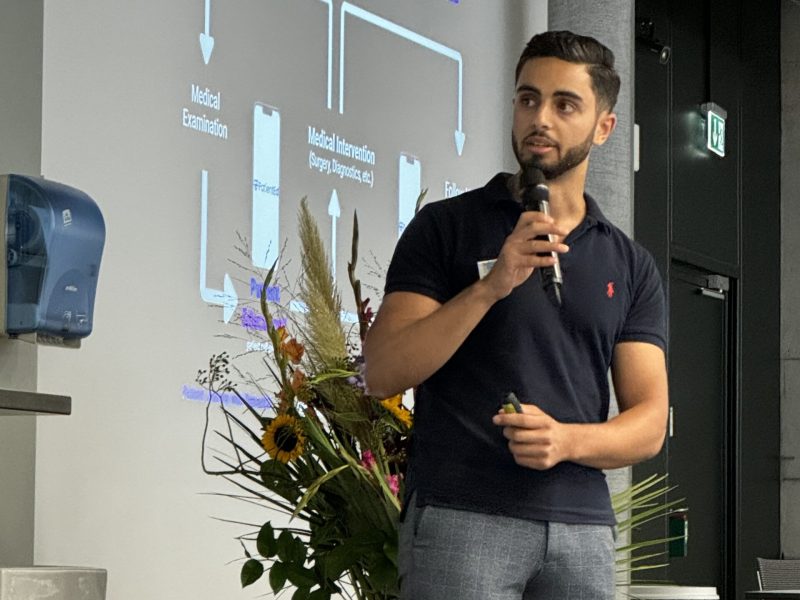
To promote acceptance and knowledge transfer within the medical community, Amr Saad actively speaks at conferences and professional events, demonstrating how digital tools like AI, telemedicine, and PatientEd solve real clinical challenges — practically, not theoretically. His goal: replace skepticism with understanding, and anchor innovation through trust.
In parallel, he is advancing PatientEd as a central platform for digital patient education, translating complex ophthalmic content into interactive, easily understood formats and establishing shared decision-making as a new clinical standard.
These initiatives reflect his understanding of digital health not as a technological trend, but as an evolutionary extension of medical responsibility — evidence-based, empathic, and efficient.